Web: https://www.gettinintuit.com/visual-art-galleries
Bio:
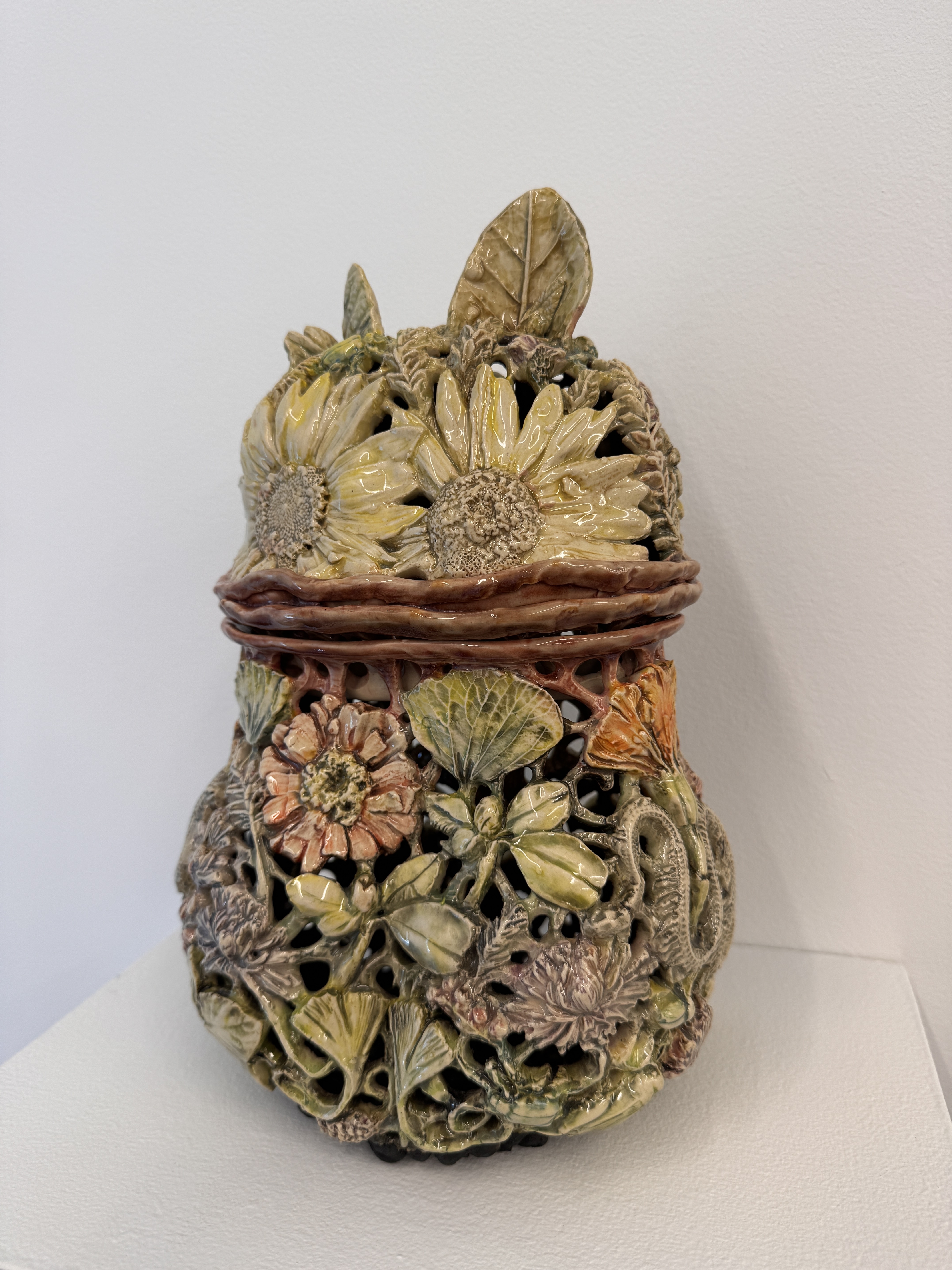
Emily Schuhmann (b. 1983, Louisville, Ky) is a Boston-based ceramic artist creating whimsical vessels, vases, and sculpture that feature botanical textures. Schuhmann earned a BFA from Ball State University in Indiana and an MFA from Texas Tech. The artist has participated in exhibitions at the American Craft Today juried by Mark Leach at The Bascom: A Center for Visual Arts in Highlands, NC, Evansville Museum, Evansville, IN, Micro Museum in New York, NY, Craft Texas juried by Gail M. Brown, Cindy Hickok, and Paula Owen, at Houston Center for Contemporary Craft, in Houston, TX, Indiana University SE New Albany, McGrath Gallery, Bellarmine University, Louisville, KY, Stanford Art Association, Stamford, CT. In addition to her artistic practice, she served as a professor and gallery director at several universities, including the University of Louisville, Indiana University Southeast, Bellarmine University, and Texas Tech. She currently lives and works in Waltham, MA, where she is also a floral designer, teaches workshops on plaster mold-making and ceramic hand-building, and is active in her local community through volunteering and land stewardship.
Artist Statment:
Emily Schuhmann is a ceramic artist creating whimsical vessels, vases and sculpture that feature botanical textures.
She collects and casts plants and flowers that carry regional specificity and seasonal ephemerality. These intricate surfaces are transferred to the clay and reformed into vases and sculpture whose tilts, textures, leans, and wobbles echo the quirks and irregularities of the natural world. The resulting playful forms recall elements of folklore and garden iconography like gnomes, while nodding to ornate and decorative ceramic traditions like the tiered Tulipieres of 17th-century Holland. Intended to be used as vases and refilled with living plant material Schuhmann’s work invites viewers and collectors into continuing contemplation and relationships with the natural world.
Through her use of replicative mold-making techniques, applied both for archival purposes and as a tool for design, her practice highlights the many ways we collect, design with, design for, and connect with nature and the natural world. The final forms, often referencing familiar animal figures and organic shapes while fulfilling traditional functions such as vases, cups, or plates, resist static classification.

